There is no shortage of articles and videos comparing traditional and Roth 401(k) contributions. Most approach the decision as an optimization problem, focusing primarily on tax rates.
The conventional advice goes something like this: “If you expect to pay a lower tax rate in retirement, choose traditional. If you expect to pay a higher tax rate, choose Roth.”
That advice isn’t necessarily wrong. But I think it overlooks something important about how most employees actually save for retirement. When you enroll in your employer’s 401(k), you’re generally asked a simple question: What percentage of your paycheck would you like to contribute?
Maybe you choose 6%. Maybe 10%. Maybe 15%.
The point is not what percentage you chose, but that almost everybody is choosing a percentage. And that’s what I believe most comparisons overlook.
Traditional vs Roth?
Traditional 401(k) contributions generally reduce your taxable income today, but withdrawals are taxed in retirement. Roth 401(k) contributions are made with funds after you’ve pay the tax on them, but withdrawals are tax-free (when certain IRS requirements are met). Both offer tax advantages; the question is when you pay the tax. If you’re unfamiliar with the differences, Fidelity has a great article summarizing the key differences.
Saving 6% in a traditional 401(k) is not the same as saving 6% in a Roth 401(k).
To understand why, let’s look at two employees earning the same salary, saving the same percentage, and investing in the same investments.
Same Salary. Same Savings Rate. Different Results.
Imagine two employees who each earn $100,000 per year.
Both decide to contribute 6% of their salary to their employer’s 401(k). Sam chooses traditional contributions, while Bill chooses Roth.
At the end of the year, both Sam and Bill have contributed exactly $6,000.
So far, their contribution amounts are identical. But there is one important difference.
Traditional contributions generally reduce taxable income. If Sam is in the 12% federal marginal income tax bracket, that $6,000 contribution reduces his federal income tax by $720 while Bill receives no such deduction.
In other words, Sam has $720 more in take-home pay, while both employees have invested the same $6,000.
That’s the first important distinction: the same contribution percentage doesn’t cost the two employees the same amount of take-home pay.
What Happens to the Tax Savings?
Here’s where I believe conventional comparisons start to diverge from how people actually behave.
When financial professionals compare traditional and Roth contributions, they often assume that the traditional employee invests the money saved on taxes. And that’s perfectly reasonable if we’re trying to determine which strategy produces the greatest wealth for an equal reduction in today’s spending.
But that’s not necessarily how an employee saving a fixed percentage of their salary behaves.
Our Sam elected to save 6%. His employer deducted 6% from his pay and deposited it into the retirement account. The remaining money went into his paycheck. Unless he deliberately saves the additional $720, it becomes part of the money available for ordinary spending.
Meanwhile, Bill has already committed that additional purchasing power to retirement by choosing Roth contributions.
Bill is effectively saving more for retirement without electing a higher contribution percentage.
This isn’t merely theoretical. In How America Saves 2026, Vanguard reports that the median elected employee contribution rate was 7% of pay. Employees frequently make retirement savings decisions by selecting a contribution percentage.
And in a study of employers introducing Roth 401(k) options, researchers found that employees did not measurably reduce their total 401(k) contribution rates after Roth became available.
That doesn’t prove everyone spends their traditional tax savings. But it supports the idea that employees don’t necessarily adjust their savings percentages to compensate for Roth’s higher immediate tax cost.
Your Account Balance Isn’t Necessarily Your Retirement Wealth
Now let’s follow our two employees into retirement.
For simplicity, assume each makes a single $6,000 contribution, earns a 10% annual investment return, and leaves the money invested for 20 years.
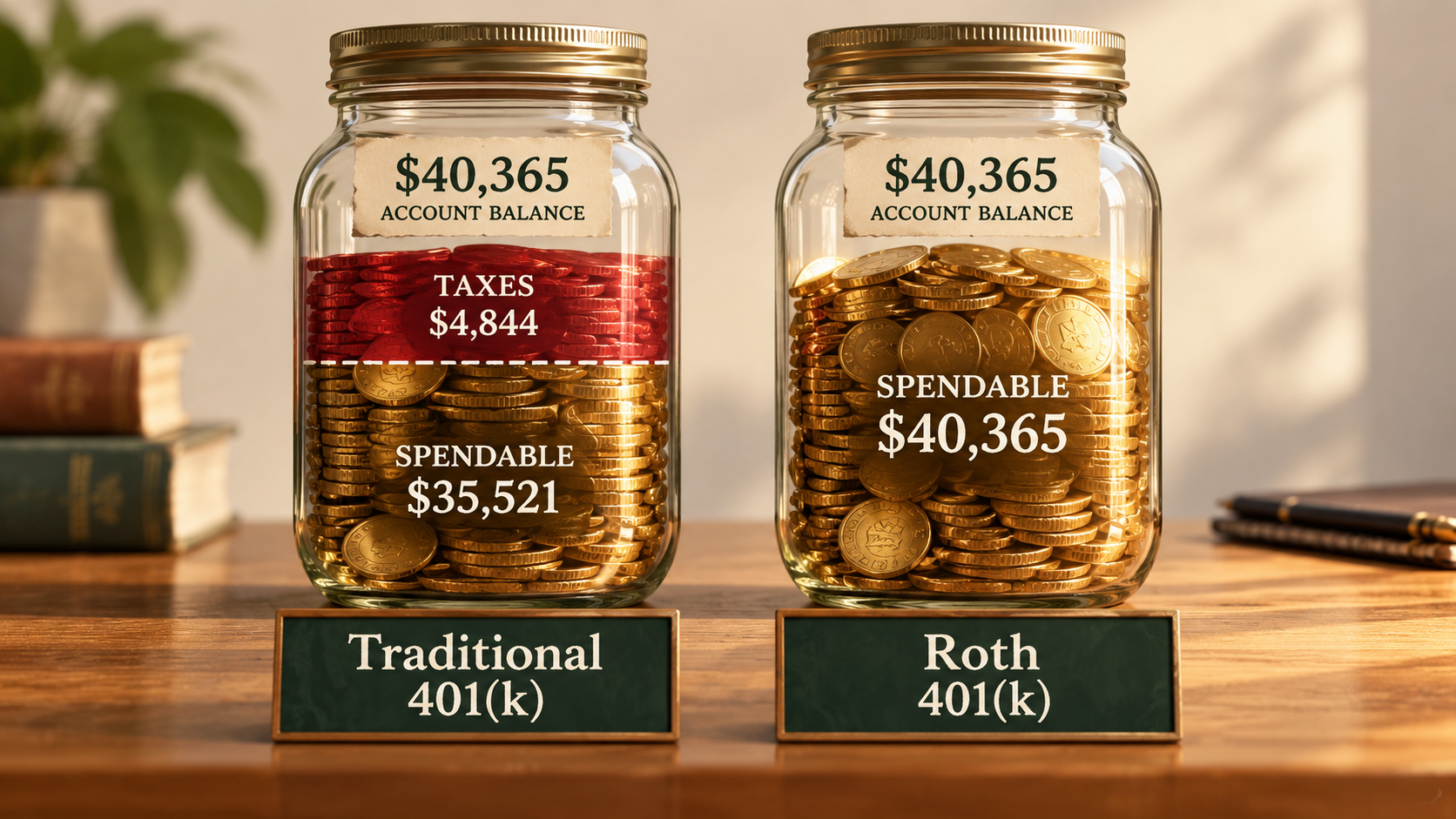
Both accounts grow to approximately $40,365.
The investments were identical. The returns were identical. The balances are identical. But the amount available to spend isn’t.
But Sam still owes income taxes when the money is withdrawn. Let’s assume they both continue to need $100,000 per year in retirement income and tax rates, deductions, and brackets are the same as today (2026).
Same Retirement Income. Different Taxes.

Although Sam’s overall effective tax rate is 7.6%, the additional income from his traditional 401(k) withdrawal is taxed at his marginal rate of 12% as opposed to Bill’s 401(k) withdrawal facing no additional taxation. (If you’re not sure why, check out the post on Marginal vs Effective Tax Rates.)
After paying approximately $7,640 in retirement income taxes, Sam only has $92,360 available to spend while Bill has $97,204: or $4,844 additional funds to spend.
Looking specifically at their 401(k) withdrawals, Sam’s $40,365 generates an additional $4,844 in federal income taxes, leaving him with just $35,521 to spend. Meanwhile Bill has the entire $40,365 at his disposal (assuming his withdrawal qualifies for tax-free treatment).
And remember, this example considers just one year’s $6,000 contribution. If Sam and Bill continued contributing the same percentage throughout their working careers, the difference in their spendable retirement wealth could become considerably larger.
And notice something important: Sam’s overall effective tax rate in retirement is lower than his marginal tax rate while working. Yet Bill still ends up with more spendable retirement income.
But Couldn’t the Traditional Employee Invest the Tax Savings?
Absolutely.
And this is the strongest counterargument to what I’m suggesting.
The traditional employee had an additional $720 in take-home pay. If they invested that money, rather than spent it, they could accumulate additional wealth outside the original 401(k) contribution.
Under the right tax assumptions, that strategy could match or even outperform Roth.
But notice what we’ve done. We’ve changed the question.
Instead of comparing two employees who each elected to save 6% of their salary, we’re now comparing an employee who saves 6% through Roth against an employee who saves 6.72% through traditional and deliberately invests the $720 saved in taxes.
That is a different savings strategy.
It’s entirely legitimate. It may even be the optimal strategy for a disciplined investor.
But it isn’t the same as selecting a contribution percentage and living on the remainder of your paycheck.
And that’s the distinction I think gets lost in conventional comparisons.
Why I Prefer Roth as the Default
I’m not suggesting that Roth is always the best choice.
Someone who needs the additional take-home pay today, expects unusually favorable future tax treatment, or deliberately invests their traditional tax savings may have good reasons to choose traditional contributions.
But for the employee who decides to save a percentage of their salary and spends the rest, I think Roth deserves to be the default choice.
It removes a decision that traditional contributions leave to the employee: what to do with the tax savings.
It also changes the meaning of the balance appearing on the retirement account statement. A qualified Roth balance represents money that can be spent without another federal income tax bill on the withdrawal. A traditional 401(k) balance is hiding a future tax liability: the account balance isn’t all your money.
The conventional comparison asks which account produces the best outcome when the employee’s current economic sacrifice is held constant.
That’s a useful question. But I think there’s another question worth asking:
If I’m going to save 6% of my salary regardless of which account I choose, which one leaves me with more spendable money in retirement?
Under the assumptions we’ve examined, the answer is Roth.
And that’s why I believe a Roth 401(k) may be worth more than most percentage-of-pay savers realize.




Leave a Reply